
Weatherby Mark V: nine locking lugs and 54 degrees
26 August 2026 · 7 min read
What Weatherby’s Mark V action solves: nine locking lugs, 54-degree bolt lift and an origin tied to its magnum cartridges.

An action born for a specific problem
The Mark V did not appear first and the cartridges afterwards. At Weatherby, it happened the other way round. Roy Weatherby had spent years working with high-capacity cartridges before having an action of his own, and during that period he built his rifles on commercial actions such as the Springfield 1903, the Winchester Model 70 or the FN Mauser 98. Weatherby’s own historical documentation places the company’s beginnings in 1945 and the arrival of the Mark V in 1958; moreover, its serial record lists “pre-Mark V” rifles from before that date. That order matters, because it explains why the Mark V was designed the way it was: not for a standard cartridge, but to house and withstand already existing Weatherby Magnum cartridges or ones already well under way in their development.
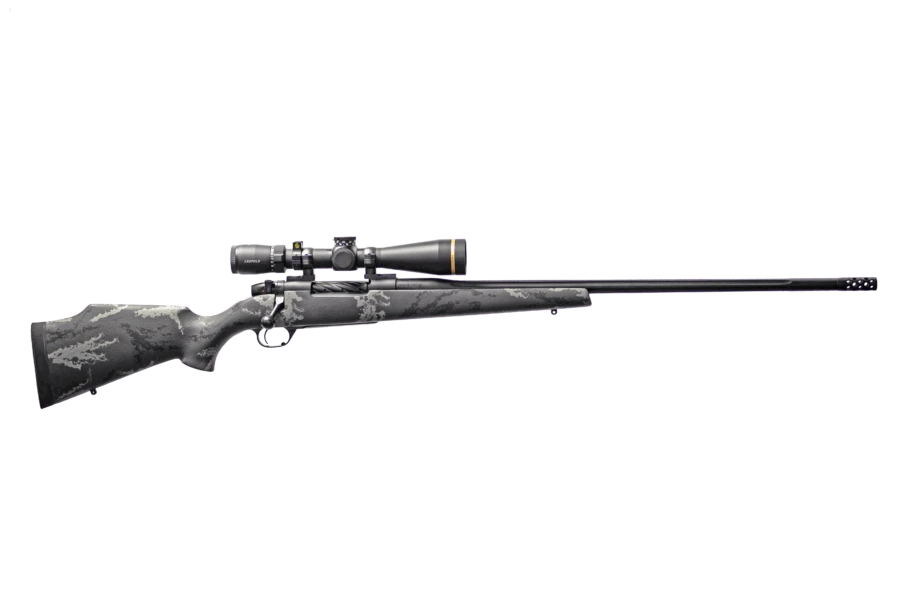
In other words, the action was an industrial answer to a family of cartridges that was already demanding something more than an adapted commercial action. Weatherby had built its identity around high velocities and large-volume cases, many derived from the .300/.375 H&H Magnum base with the characteristic double-radius shoulder. When that cartridge line ceased to be a workshop experiment and became a stable catalogue offering, the company needed an action of its own with sufficient structural margin and operating geometry conceived for that context.
Why nine locking lugs
The best-known feature of the Mark V is its bolt head with nine locking lugs on the magnum actions. Weatherby itself still distinguishes today between nine-lug magnum Mark V receivers and six-lug standard-calibre Mark V receivers, a division that appears both in its historical identification tables and in later technical documentation. That persistence indicates that the nine locking lugs are not an aesthetic detail or a collector’s oddity, but the core of the Mark V concept for magnum cartridges.
The mechanical logic is straightforward. With more locking surface distributed around the bolt head, the action spreads firing stresses better and can do so in a body that remains relatively compact in rotational length. In Weatherby literature and in technical articles hosted by the brand itself, the Mark V was presented precisely as an action of great strength, to the point of becoming popularised with the formula “The World’s Strongest Action”. Beyond the slogan, what matters is that Weatherby was seeking an overbuilt action for the pressures and cartridge volumes associated with its magnum family.
It is also worth clarifying that this design was not immutable. Weatherby’s official material makes it clear that, since 1996, the Mark V has coexisted in two functional sizes: the nine-lug magnum and the six-lug standard. The nine-lug version remains reserved for the firm’s long and powerful cartridges, while the six-lug version is used for standard-bolt-face cartridges or for proposals such as the 6.5 Weatherby RPM. That underlines the original idea even more strongly: when Weatherby speaks of the Mark V in the historical sense, the foundational model is the nine-lug one.
The bolt lift angle: from 56 to 54 degrees
The second figure inseparable from the Mark V is the bolt lift angle. In the technical documentation preserved by Weatherby on the model’s history, it is explained that the action was born with a 56-degree lift and that today it is cited as 54 degrees. In technical texts hosted on the brand’s website, that transition appears explicitly: “56-degree bolt lift (now 54-degrees)”.
Why does that figure matter Because it reduces the angular travel needed to unlock the bolt compared with two-lug actions with a wider lift. Put another way, the Mark V achieves a short unlocking movement thanks to the multiple arrangement of its locking lugs. That smaller angle leaves more clearance between the bolt handle and the riflescope eyepiece, something especially useful on rifles intended from a very early stage for hunting with optics mounted low over the bore axis.
There is no need to exaggerate its effects in order to understand its value. A bolt that opens in 54 degrees does not by itself make the rifle more accurate, nor does it replace other design factors, but it does define the ergonomics of the whole. The Mark V was conceived at a time when Weatherby wanted to combine fast cartridges, hunting rifles and the systematic use of scopes. The short bolt-lift angle fits that idea better than a conventional action with high lift.
Before the Mark V, the magnum problem already existed
The underlying question is why Roy Weatherby did not settle for continuing to use other makers’ actions. The answer lies in the brand’s own timeline. Weatherby states that Roy Weatherby began experimenting with wildcat cartridges during the Second World War and that by 1945 he was already manufacturing rifles and ammunition full time. By contrast, the Mark V did not appear until 1958, with the first American units dated between 1958 and 1959 and later German production from 1959 onwards.
That gap of more than a decade between the cartridges and the proprietary action explains the decision. Weatherby Magnum cartridges had been born and had gained fame before the Mark V existed. While the company depended on commercial actions, the cartridge was ahead of the platform. Designing an action of its own made it possible to reverse that relationship: there would no longer be any need to adapt each rifle to an especially ambitious magnum cartridge, but rather to create a foundation conceived from the outset for it.
Moreover, Weatherby’s official chronology preserves that transition quite clearly. In its identification table there appear, on the one hand, “pre-Mark V” rifles on FN Belgian Mauser, Brevex Magnum, Schultz & Larsen or FN Sako Mauser actions; on the other, the irruption of the Mark V from 1958 onwards. The reading is direct: there was an earlier stage in which the Weatherby cartridge relied on third-party actions, and a second stage in which the brand decided that its technical proposition required an action of its own.
Strength, size and later evolution
Over time, the Mark V family has diversified, but the original architecture is still visible. A technical text hosted by Weatherby on the 6.5 Weatherby RPM even compares the receiver ring diameter: around 1.331 inches on the nine-lug Mark V action versus 1.149 inches on the six-lug one. It is not a minor detail. It indicates that Weatherby differentiates not only the number of locking lugs, but also the overall receiver volume according to the type of cartridge for which each version is intended.
That helps explain why the classic Mark V became associated with cartridges such as .300 Weatherby Magnum, .340 Weatherby Magnum, .378 Weatherby Magnum, .416 Weatherby Magnum or .460 Weatherby Magnum in various specification sheets from the brand. It is not merely an action famous for its short bolt lift, but a platform dimensioned for true magnum ammunition.
The evolution from 56 to 54 degrees and the current coexistence of six- and nine-lug actions do not contradict the original idea; they refine it. Weatherby has gone on adjusting the system, but the approach remains the same as it was in the late 1950s: a bolt action designed around the requirements of its cartridges, not the other way round.
What sets the Mark V apart
If the Mark V had to be summed up in a single sentence, it would be this: Weatherby designed an action of its own when its magnum cartridges had already outgrown the logic of the adapted commercial action. The nine locking lugs answered a need for strength and stress distribution; the short bolt lift answered a need for handling and scope compatibility. Both solutions are part of the same technical problem.
That is why the Mark V occupies a singular place in the history of the post-war bolt-action rifle. It was not born to cheapen a catalogue or to copy an external system with a different stock. It was born to give the Weatherby Magnum cartridges a home of their own. And that priority can still be read today in two very specific figures: nine locking lugs and 54 degrees.