
Caldwell Lead Sled and front rests
03 September 2026 · 7 min read
What the Lead Sled does with recoil and how Caldwell organises its front-rest families for bench, field and bags.
A brand with several ways to support the firearm
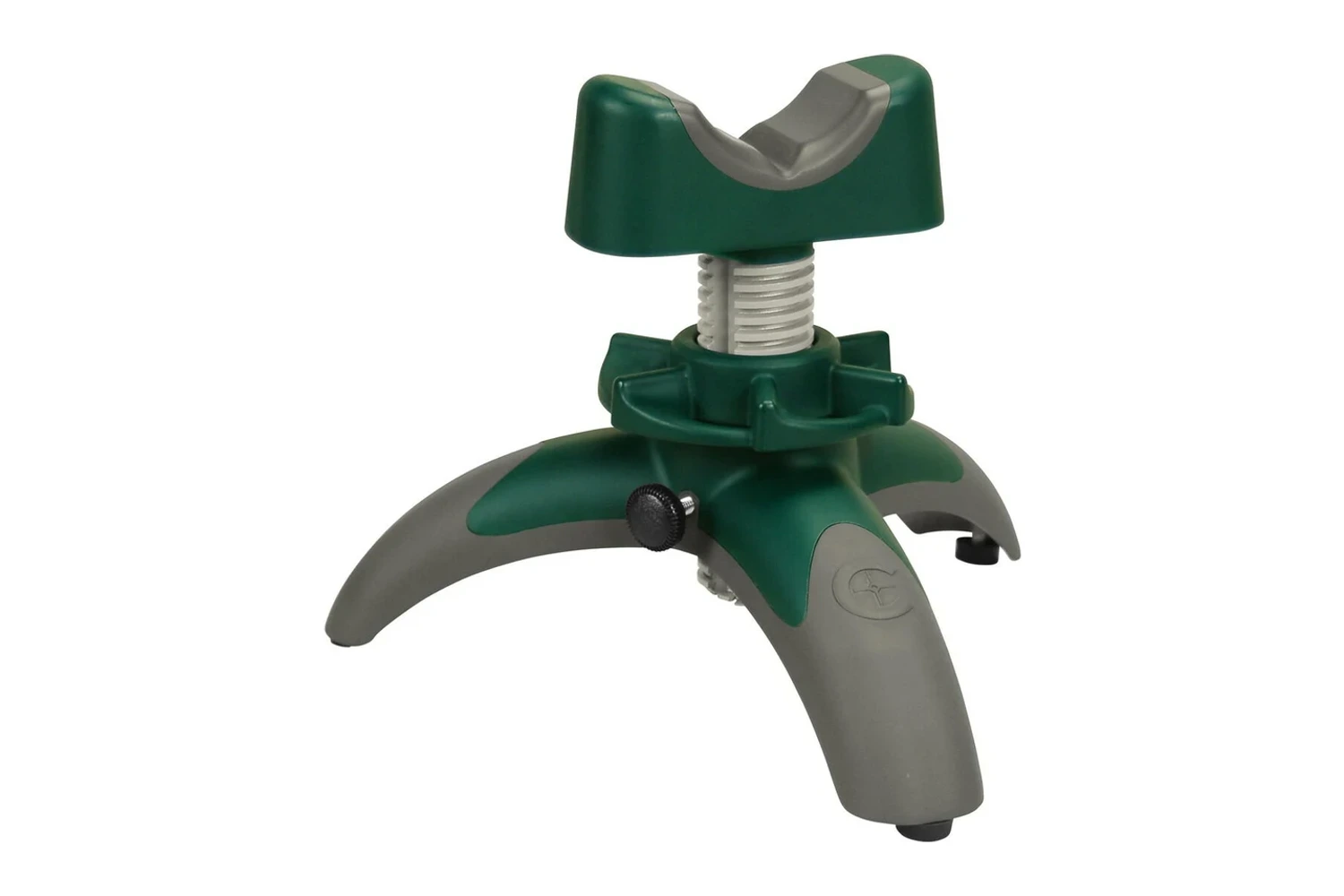
Within Caldwell’s catalogue, shooting rests do not form a single homogeneous family. The brand clearly separates heavy sighting-in benches, precision front rests, light and convertible supports, and shooting bags. That organisation matters because the Lead Sled does not serve the same function as a The Rock, a Handy Rest NXT or a Tack Driver: the former is designed to add mass to the set-up and manage recoil; the others prioritise front-rest stability, portability or speed of deployment.
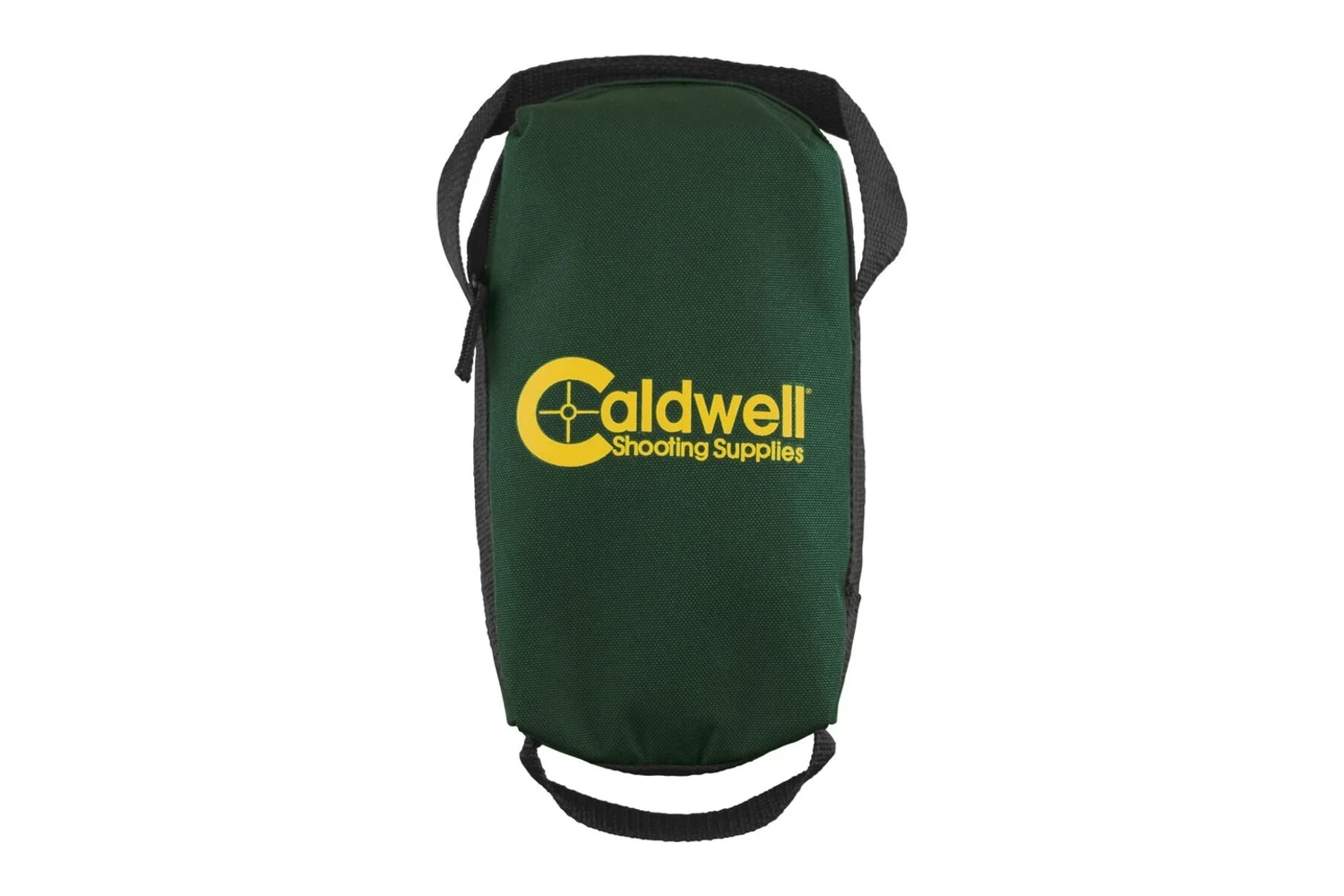
On the general Shooting Rests page, Caldwell brings together in a single section models such as Lead Sled MAX, Rock BR Competition Front Shooting Rest, The Rock Deluxe Shooting Rest, Precision Turret Shooting Rest, Zero-Max, Matrix, 7-Rest, Handy Shooting Rest NXT, Steady Rest NXT, as well as the DeadShot and Tack Driver bag lines. That coexistence in one section can give the impression that they all do the same thing, but the description of each product itself shows that they do not: some are complete benches, others are only front rests, and others are bags designed for use on almost any surface.
What the Lead Sled does with recoil
The central idea of the Lead Sled is simple: it does not eliminate the real recoil generated by the shot, but it does reduce the recoil perceived by the shooter very significantly by combining a rigid structure with added weight and a cushioned rear cradle. For more than twenty years, Caldwell has presented this family as its solution for “saving shooters’ shoulders from heavy recoil”, and in the current generation it states reductions of up to 95 % of perceived recoil in the Lead Sled MAX, Lead Sled DFT 3 and Lead Sled 4 models; in the Solo 2 the stated figure drops to 85 %.
That effect is achieved in three ways. The first is additional mass. In the Lead Sled 4, for example, the tray accepts the brand’s specific bags, lead shot or 35 lb barbell plates. In the DFT 3, Caldwell repeats that same logic of an adjustable tray for bags, shot or 35-pound plates. In the Solo 2, the tray accepts up to 50 lb of lead or the brand’s specific reservoir. And in the Lead Sled MAX the weight is placed in a removable reservoir that can be filled with water, sand, gravel or other materials. The more mass that is added to the set-up, the less movement is transmitted to the shooter’s shoulder.
The second way is the rear cradle with a cushioning pad. Caldwell states for the Lead Sled 4 that the rear support incorporates a Shock Eliminating recoil pad to add recoil reduction and protect the firearm and scope from heavy recoil. In the DFT 3 the brand adds, in addition to that pad, a vibration dampener in the rear support. In the Solo 2, the rear support “protects the shooter’s shoulder as well as the firearm and scope from recoil”. In other words, the system not only aims to make the session more comfortable, but also to limit the sharp impacts that can be transferred to the stock and the optic.
The third way is the retention of the firearm in a guided structure. The rifle or shotgun does not recoil freely against the shoulder as it does when fired from a soft rest; it remains contained between the front bag or cradle and the buttstock support. That is why Caldwell associates the Lead Sled with sighting-in the scope and with reducing “flinching”, the anticipatory movement before the shot that usually appears with hard-recoiling firearms.
It is worth clarifying what this means in practice. The Lead Sled is designed to cushion the blow received by the shooter and stabilise the firearm during sighting-in, not to change ballistics or to replace the firearm’s real behaviour in field shooting. That is why this family itself coexists with more conventional benches and with separate front rests: Caldwell distinguishes between managing recoil and supporting the firearm precisely.
The Lead Sled family within Caldwell
The generation that Caldwell now presents under the informational page New Generation of Lead Sleds arranges the family into four main models. The Lead Sled MAX is the most modular: it transforms into three configurations and uses a removable reservoir as ballast. The Lead Sled DFT 3 retains the dual frame architecture with 6 inches of length adjustment and benchrest-style elevation and windage adjustments. The Lead Sled 4 keeps the classic format with compatibility improvements for firearms with detachable magazines and lever actions. And the Solo 2 simplifies the concept with a single support line and more basic elevation adjustment.
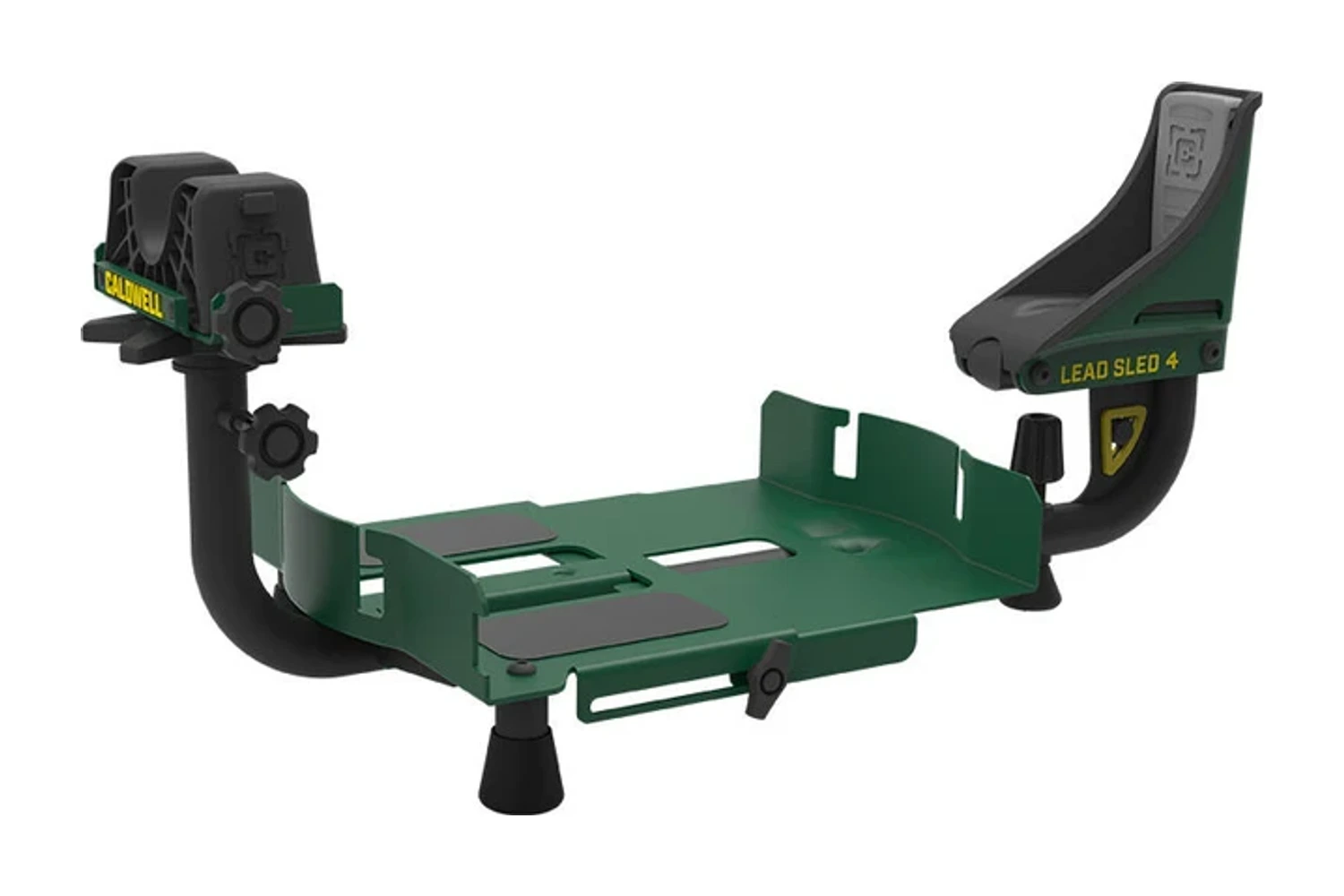
Seen this way, the Lead Sled is Caldwell’s answer for anyone wanting a bench platform that, in addition to holding the firearm, absorbs a large part of the energy that would normally reach the shoulder. The commercial figure most often repeated by the brand is that “up to 95 %” of perceived recoil, but the catalogue itself shows that not all models reach the same reduction and that ballast capacity varies between versions.
What front-rest families Caldwell makes
If the Lead Sled is left aside and the rest of the catalogue is considered, Caldwell makes several fairly recognisable front-rest families.
The first is the The Rock family, which brings together heavy-built bench front rests. In that line appear The Rock Deluxe Shooting Rest, The Rock Jr. and the Rock BR Competition Front Shooting Rest. The common denominator is a rigid base, height adjustment and interchangeable front bags. The The Rock Deluxe is described as having cast-iron construction, independently adjustable legs and an adjustable, lockable front support. The Rock BR, more geared towards precision bench shooting, adds windage correction with fingertip control and elevation adjustment by means of a two-stage rotary system with bearings, with up to 11.5 inches of fine adjustment.
The second is that of compact mechanical front rests, where models such as Handy Shooting Rest NXT fit. Caldwell expressly defines it as a very versatile front rest, built from lightweight materials and with an adjustment equivalent to six feet at 100 yards. In addition, it can be converted for handgun use by means of a removable accessory. Here the priority is no longer bench weight, but having a simple, transportable front rest.
The third is that of convertible full-length benches, an intermediate area between a front rest and an integral support. Here belong Matrix, Steady Rest NXT, Zero-Max, 7-Rest and Precision Turret. They are not pure front rests in the strict sense because they also incorporate rear support or additional retention, but many of their solutions originate at the front end. The Matrix can work as a front rest or a full-length rest; the Steady Rest NXT can be used only with the front section or as a front and rear rest; the Precision Turret incorporates a front clamp and pan-and-tilt controls; the Zero-Max offers a filled front bag and a padded rear cradle; and the 7-Rest uses an offset lateral geometry to leave clearance for long magazines.
The fourth family is that of front support bags. Here Caldwell maintains two clear lines. DeadShot is the range of classic front, rear and combined bags, intended to provide stable support on almost any surface. Tack Driver, by contrast, is the one-piece bag version that replaces the front-and-rear set, with a self-tightening surface and support for almost any rifle or shotgun. In both cases, the front support ceases to be a metal structure and becomes a conformable bag.
How to understand the catalogue at a glance
If the catalogue is arranged by function, Caldwell works with three broad logics. The first is absorbing recoil and securing the firearm, which is the territory of the Lead Sled. The second is providing a heavy, adjustable bench front rest, which corresponds to The Rock and especially to the Rock BR. The third is supporting with less weight and greater versatility, where the NXT models, Matrix, 7-Rest and the DeadShot and Tack Driver bags come in.
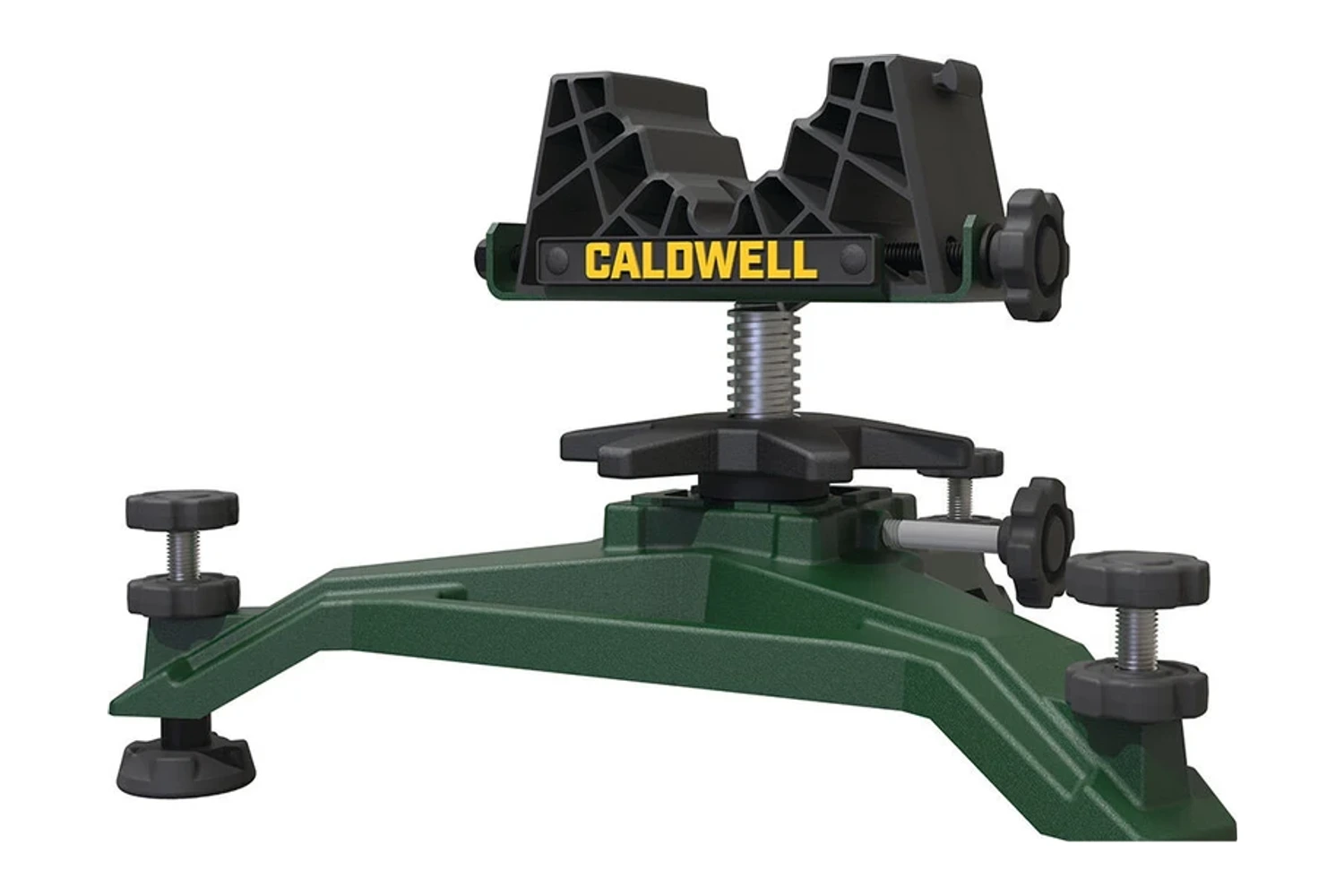
That is why, when asked what the Lead Sled does with recoil, the correct answer is not only that it “reduces” it, but how it reduces it: by adding mass, cushioning at the buttstock and containing the firearm in a guided structure. And when asked about Caldwell’s front-rest families, the brand does not offer a single answer, but several: heavy The Rock bench front rests, compact front rests such as Handy Rest NXT, convertible full-length supports and DeadShot and Tack Driver support bags. That is, at least, the classification that emerges from Caldwell’s current official website.