
Lyman: O-frame and C-frame bench presses today
26 August 2026 · 6 min read
What changes between an O-frame and a C-frame bench press, and which reloading press models Lyman still keeps in its catalogue today.
Two bench architectures, two ways of understanding rigidity
When bench reloading presses are discussed, the difference between an O-frame press and a C-frame press is not a catalogue nuance. It is a matter of mechanical architecture. The O-frame press closes the frame around the working area and forms a more complete structural ring; the C-frame press leaves one side open and makes access to the shell holder and die area easier. That difference affects perceived rigidity, the space available and also the role each model usually takes on at the reloading bench.
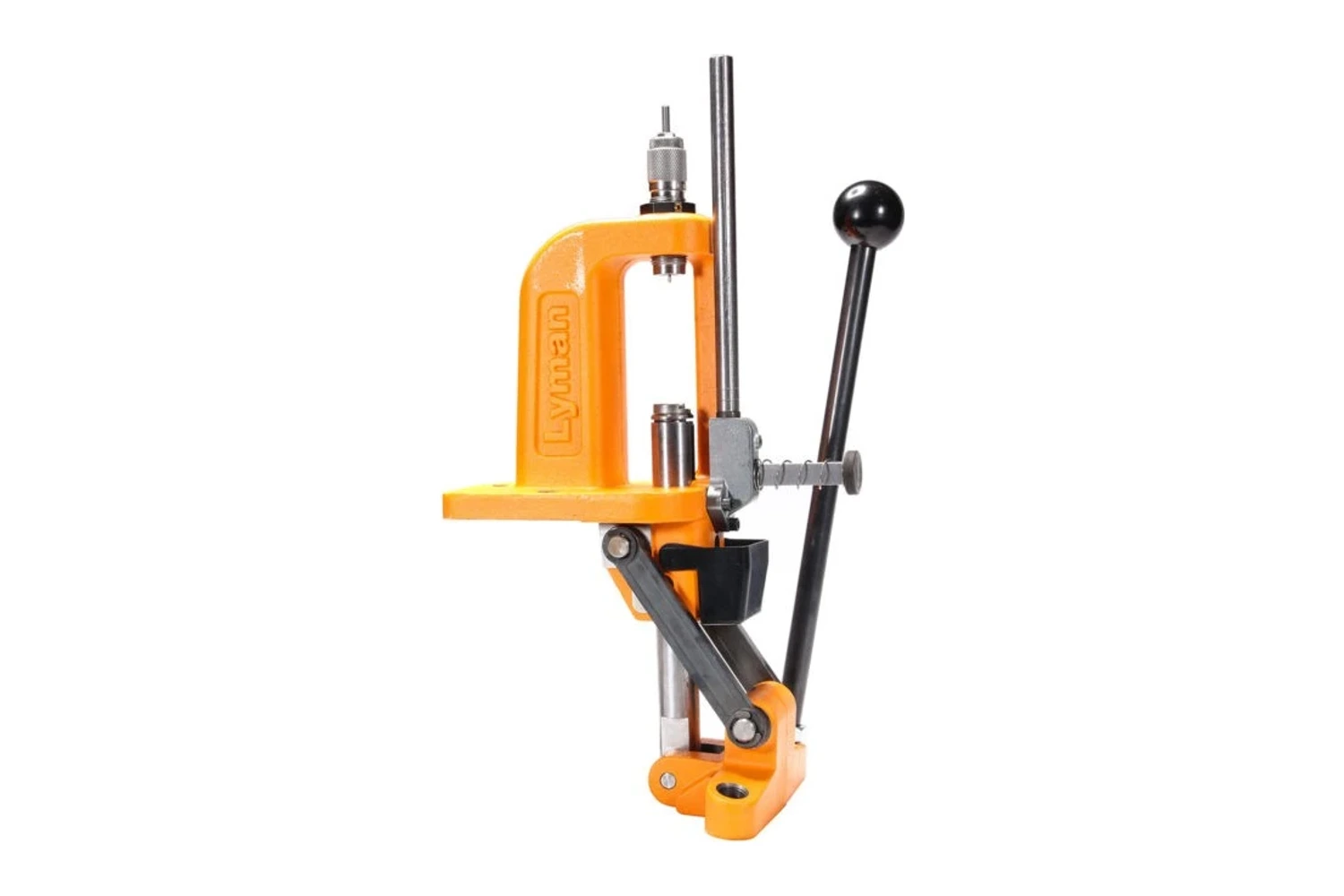
In Lyman’s current range that distinction can be seen clearly. The Brass-Smith Victory Press is the single-stage O-frame press. The brand describes it as having a cast-iron frame, a 1-inch diameter ram, 5-inch frame opening, use with standard 7/8x14 dies and standard shell holders. It also incorporates linear primer feed with large and small tubes and steel shielding around the tubes. (lymanproducts.com)
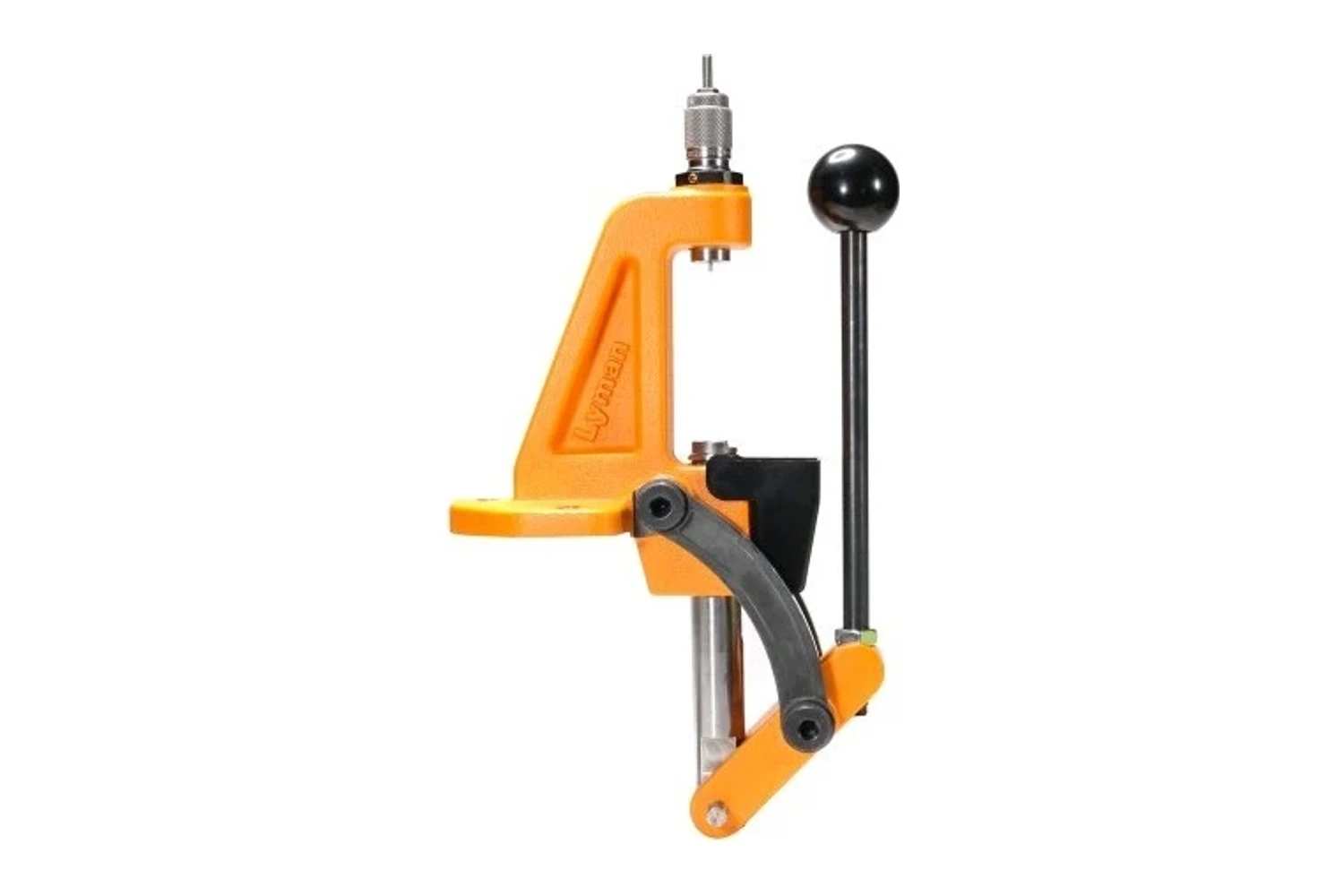
Set against it, the Brass-Smith Ideal Press represents the C-frame solution within Lyman’s press archive. It also uses a cast-iron frame, works with standard 7/8x14 dies and standard shell holders, has compound linkage and a 1-inch ram, but in a more compact assembly: Lyman states a 3 7/8-inch opening and specifies that it handles handgun ammunition and rifle cartridges with a loaded overall length of up to 3,700 inches. Its handle is in a central position for ambidextrous use. (lymanproducts.com)
That comparison is enough to frame the debate. An O-frame press such as the Victory prioritises structural closure of the frame and interior clearance. A C-frame press such as the Ideal gives up some of that closure in order to gain side access and reduce bench footprint. That does not mean one is "good" and the other is a "compromise"; it means they solve different problems.
What truly distinguishes an O from a C
The classic advantage of the O-frame press lies in the rigidity of the frame. By enclosing the working area, the structure distributes loads better and reduces the tendency to flex when carrying out operations that put heavy load on the handle. Lyman does not express that idea in theoretical terms, but it does emphasise of the Victory that it is an especially robust and rigid press, built on a cast-iron O-frame and intended to work even with the largest cases thanks to its 5-inch opening. (lymanproducts.com)
The C-frame press, for its part, is distinguished by access. The open side clears the entry and exit of the case and leaves more free space around the shell holder. In practice, that translates into a machine that is very convenient when an auxiliary station or a setup that takes up little bench space is wanted. With the Ideal Press, Lyman stresses precisely that condition: compact design, minimal space requirement and the role of an entry-level or support press for a specific operation separate from the main press. (lymanproducts.com)
The usable size also changes. The Victory offers a 5-inch opening; the Ideal remains at 3 7/8 inches and Lyman limits it to cartridges up to 3,700 inches in loaded overall length. That figure does not automatically make the Victory a “more precise” press, but it does place it in a broader usage band when long cases or setups demanding more working clearance come into play. (lymanproducts.com)
Another point is weight. Lyman states 18.1 pounds for the Victory and 13.8 pounds for the Ideal. It is not a decorative figure: in bench machinery, weight usually goes hand in hand with the volume of cast iron and with the sense of being planted under load. (lymanproducts.com)
The press models Lyman manufactures today
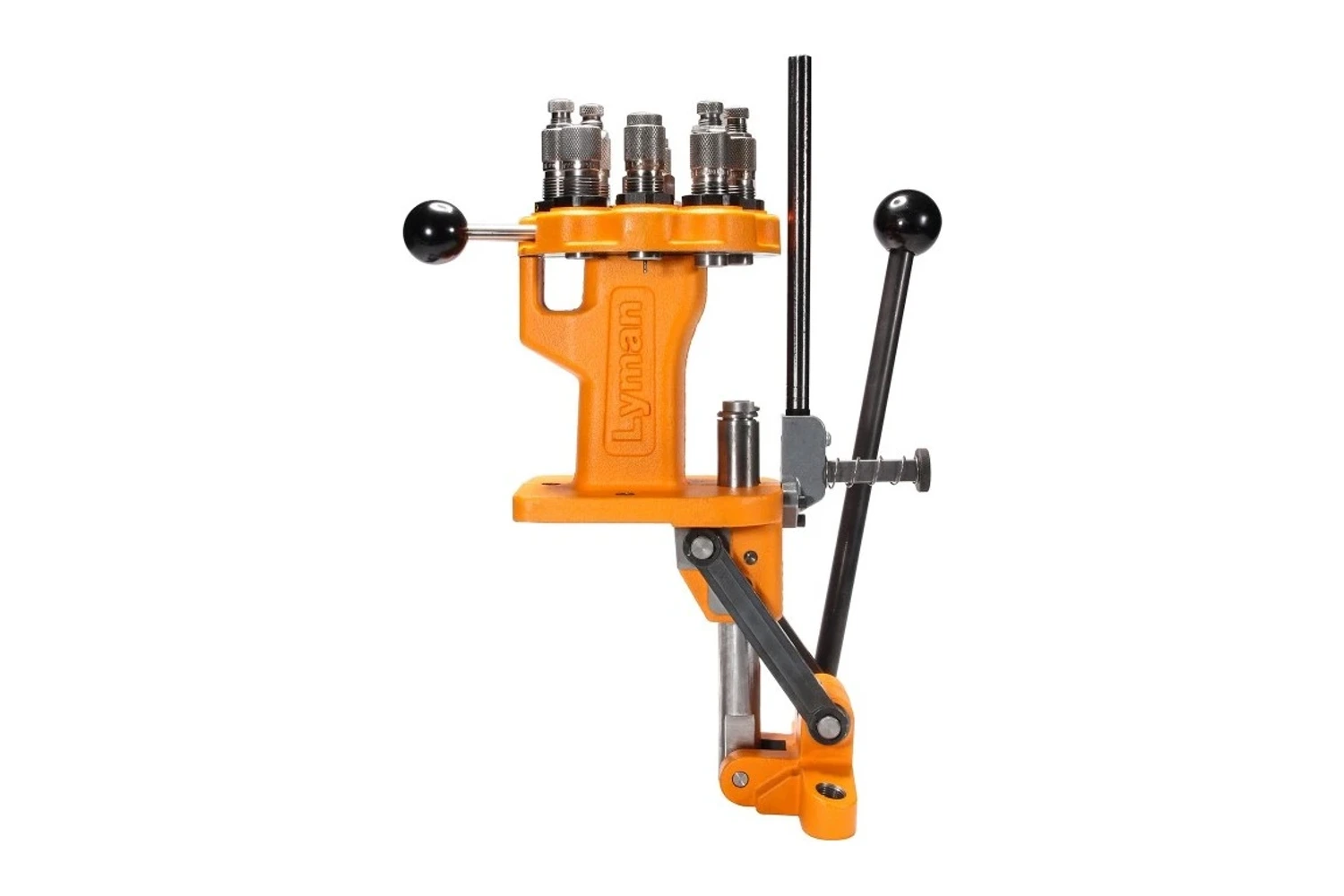
If one looks at Lyman’s live catalogue in August 2026, the company’s family of manual reloading presses has been simplified compared with other periods. On the Lyman Presses page, four references appear today, but two of them are bench stand sets. As presses proper, the catalogue shows two models: the Brass-Smith All-American 8 Turret Press and the Brass-Smith Victory Press. (lymanproducts.com)
The Victory Press is the single-stage O-frame press. Lyman presents it as the “workhorse” of its line: cast-iron frame, 1-inch ram, compound linkage, 5-inch opening, linear primer feed with large and small tubes, steel shielding in the system and the option to mount the handle for right- or left-handed use. Its stated compatibility is the usual one in this category: 7/8x14 dies and standard shell holders. The stated weight is 18.1 pounds. (lymanproducts.com)
The All-American 8 Turret Press does not fall within the O-versus-C opposition because it plays in another category: it is an eight-station turret. Even so, it helps to understand where Lyman has taken its current offering. The brand states that the turret, made of machined cast iron, has eight stations, is removable and can accommodate two complete four-die sets or up to four two-die sets. Beneath the turret there is a cast-iron frame, a 1-inch ram and compound linkage. It also incorporates linear primer feed with large and small tubes, steel shielding, ambidextrous handle use, standard 7/8x14 thread and standard shell holders. The stated weight rises to 23 pounds. (lymanproducts.com)
And where the Ideal Press stands today
The important question here is which models Lyman manufactures today. Based on the documentation consulted, the cautious answer is this: in the press catalogue currently accessible on the official website, the Victory Press and the All-American 8 Turret Press appear as current stand-alone presses, while the Ideal Press appears in the press archive and in the combined instruction manual, and also continues to be mentioned in earlier commercial material and in older combinations with the universal stand. (lymanproducts.com)
That combination of sources allows a reasonable inference: the Ideal forms part of the recent history of the Brass-Smith range, but not of the main stand-alone press offering visible today in Lyman’s general catalogue. What should not be done is to claim more than the sources say: on the pages consulted, the website provides no express discontinuation note or official withdrawal date. (lymanproducts.com)
A shorter range, but a clearer one
A reading of the current catalogue leaves an underlying idea. Lyman today maintains a bench press offering centred on two very clearly defined steps: a single-stage O-frame, the Victory, and an eight-station turret, the All-American 8. Between them, it covers the bench that seeks rigidity and wide opening in a single station and the bench that prefers to keep several die sets mounted in a heavy turret. (lymanproducts.com)
The C-frame press, represented by the Ideal in the brand’s recent historical documentation, remains useful for explaining the concept: less bulk, more direct access and a clear vocation as a compact or auxiliary press. But if the question is strictly what the firm manufactures today in its main press catalogue, the answer documented by the official website points to the Victory and the All-American 8. (lymanproducts.com)
In other words: at Lyman, the difference between O and C is not an abstract discussion. The O, in the Victory, translates into more frame around the work, more opening and more mass. The C, in the Ideal, translates into access and compactness. And the brand’s current offering has today been concentrated in the single-stage O-frame and the heavy eight-station turret. (lymanproducts.com)