
American Outdoor Brands · Cuchillería 2026 · página 192 de 196

Texto de esta página
STEEL INFORMATION
Steel is a critical component of any knife. The purpose of this guide is to provide a Impact Strength: The ability of a material to resist cracking due to a sudden force.
more detailed look into steel to help assist you in better defining what your own
preferences are and why. As a word of caution this information is not intended to Rockwell Test (HRC): A measurement of steel hardness based on the depth of pene-
be all-inclusive nor could it ever be as the world of steel is ever evolving. The quest tration of a small diamond cone pressed into the steel under a constant load.
for higher performance steels has led to the development of many new, excellent
materials over the years and there are currently over 3,000 different types of steel, Tensile Strength: Indicated by the force at which a material breaks due to stretch-
each having its own positive and negative attributes. ing. Provided by the elements Chromium (Cr) and Manganese (Mn).
Of course steel is not the only factor that determines a knife’s performance. Blade Toughness: The ability of a material to resist shock or impact. Provided by the
geometry, heat treatment processes, handle geometry and other materials used in element Chromium (Cr).
the production of the knife all contribute to how the end product will handle par-
ticular jobs. It is not possible to tell just by looking at a blade how well the item has KNIFE STEEL SELECTION CHART
been heat treated and it is only possible to make an educated guess as to how well
the handle and blade geometry will work. However, by knowing the grade of steel 1070: This is a plain carbon steel which means it has a low resistance to corrosion
used you are better able to understand the alloying elements involved giving you and low to medium edge retention. The benefit of this steel is that it is very easy to
something measurable to go by when determining your own preferences. sharpen and will take an extremely sharp edge.
The result of knowing the grade of steel can unfortunately put the end user into a 1095: This is a plain carbon steel which means it has a low resistance to corrosion
trap of placing too much of an emphasis on the steel itself. A knife is more than just and low to medium edge retention. The benefit of this steel is that it is very easy to
the steel that goes into it and it’s important to recognize this. In fact, so many mod- sharpen and will take an extremely sharp edge.
ern steels perform so well that knife decisions can often be made based on other
factors than just the marginal increases in steel performances. 4034: A good quality grade of stainless steel. This steel is known for its ability to be
honed to a razor sharp edge. While this steel has medium edge retention it is a very
Often the question of “what’s the best steel” or “which steels rank better than others easy steel to field sharpen. A choice steel to use for an everyday carry product.
in terms of best to worst” come up. There is never a truly correct and accurate
response to this as the blade geometry of the product, the quality of the heat 4116: A fine grained stainless steel. The balance of Carbon and Chromium content
treatment, the materials used and the tasks, or goals, of the end user all will factor in give it a high degree of corrosion resistance and also impressive physical character-
to determine how well a product will perform and in turn how well the user will be istics of strength and edge holding. Edge retention in actual cutting tests exceeded
satisfied with the product. blades made of 420 and 440 series of stainless steels. Other alloying elements con-
tribute to grain refinement which increase blade strength and edge toughness and
AOB Products Company uses specific blade steels to create the most efficient bal- also allow for a finer, sharper edge.
ance of properties based on the anticipated applications of our products.
420J2: A good quality stainless steel commonly used in knife blades as well as for
Steel is an alloy of iron, other metals and carbon. Stainless steel refers to a family impact cutting tools such as axes, hatchets and machetes. Known as a hard, strong
of corrosion-resistant alloy steels which contain a minimum of 10.5% chromium. A steel, this steel has decent edge holding capabilities and is easy to resharpen, stick-
common misconception is that stainless steels will not stain, rust, or corrode. Stain- ing a good balance of the most desirable traits for knife steel.
less steels will simply stain less than other steels that do not contain chromium. Each
alloy in the various steels lends unique properties to the stainless steel. 2Cr13: A good quality stainless steel commonly used in knife blades as well as for
impact cutting tools such as axes, hatchets and machetes. Known as a hard, strong
When selecting the steel for the various products we factor in the overall performance steel, this steel has decent edge holding capabilities and is easy to resharpen.
requirements of what the tool will be used for, the goal price range for the end prod-
uct and the costs of manufacturing and finishing the item(s). As with any materials 3Cr13: A good quality stainless steel commonly used in knife blades as well as for
there are generally trade-offs. For instance, while higher alloy levels and final hardness impact cutting tools such as axes, hatchets, and machetes. Known as a hard, strong
levels keep an edge longer they also will make it more difficult to field sharpen a steel, this steel has decent edge holding capabilities and is easy to resharpen, stick-
blade. Some alloys can be found to be low in nickel, which will result in increased ing a good balance of the most desirable traits for knife steel.
staining if not kept regularly oiled and cleaned after use. Knives that will be placed
to hard use must be constructed with very tough steel materials so we will use steels 7Cr17MoV: A good quality stainless steel that has a high tensile strength. This steel
that are considered to have high ductility (or toughness) over a higher hardened steel. has excellent corrosion resistance and can be honed to a razor sharp edge.
Please note that final hardness levels are achieved not only by factors of composition
but from proper heat treating and quenching, of which we pay great attention. 8Cr13MoV: A high quality stainless steel similar in properties to AUS-8. This steel
exhibits extreme toughness and excellent edge retaining capabilities.
AOB Products Company sources premium steel from many international suppliers.
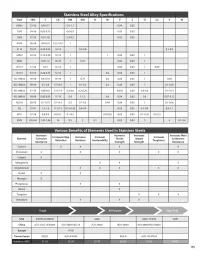
The information chart referenced below shows a reasonable range of the compo- 9Cr14MoV: A high quality stainless steel. This steel has good corrosion resistance
sitions of the various steels we utilize. The blade steel we use for each product is and excellent edge retaining capabilities.
included in the catalog to help make this information easy for you to locate.
9Cr18MoV: A higher end stainless steel commonly used in precision surgical
STEEL TERMS instruments. This steel has good corrosion resistance and excellent edge retaining
capabilities.
Alloy: A material that is dissolved in another metal in a solid solution. A material that
results when two or more elements combine in a solid solution. AUS-8: A very high quality stainless steel known for extreme toughness and excel-
lent edge retaining capabilities. This steel has great corrosion resistance and is easy
Corrosion Resistant: The ability of a material to resist deterioration as a result of a to sharpen.
reaction to its environment. Provided by the elements Chromium (Cr), Copper (Cu),
Molybdenum (Mo) and Nitrogen (N). D2: An air hardened tool steel. Sometimes called a “semi-stainless” steel because it
does contain 12% Chromium. This steel offers exceptional edge retention as well
Ductility: The ability of a material to be stretched or drawn, plastically deform as decent corrosion resistance. Somewhat difficult to sharpen, this steel can be
appreciably before fracturing. Provided by the element Manganese (Mn). finished to a high polish shine.
Edge Retention: The ability of a material to resist abrasion and wear. Provided SK-5: The Japanese equivalent of American 1080 steel, a high carbon steel with
by the elements Carbon (C), Chromium (Cr), Manganese (Mn), Nitrogen (N) Carbon between 0.75%-0.85% and 0.60%-0.90% Manganese. This grade of steel
and Vanadium (V). has an ideal balance of very good blade toughness with superior edge holding
ability and is used in a variety of hand tools and cutting products.
Hardness: The resistance of a steel to deformation or penetration analogous to
strength. Provided by the elements Carbon (C), Chromium (Cr), Cobalt (Co), S30V: This steel contains Carbon along with high amounts of Chromium,
Molybdenum (Mo), Nitrogen (N) and Phosphorus (P). Molybdenum and Vanadium. Double tempered for hardness and edge retention
this steel has excellent corrosion resistance, but is somewhat difficult to sharpen.
Hardenability: The ability of a steel to be hardened by a heat treating process.
Provided by the elements Manganese (Mn), Molybdenum (Mo) and Tungsten (W). Ceramic: A ceramic is an inorganic, non-metallic solid prepared by the action of heat
and subsequent cooling. When used in the application of a knife blade, the ceramic
Heat Treating: A controlled heating and cooling process to prescribed temperatures and material will stay sharp for much longer than that of a steel knife. The only drawback
set limits for the purpose of changing the physical properties and behavior of the metal. is the ceramic material is more brittle than steel and can snap from a hard impact.
192