
American Outdoor Brands · Cuchillería 2026 · página 194 de 196
Texto de esta página
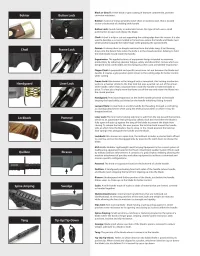
Black or Grey Ti: A thin black or grey coating of titanium carbonitride, provides
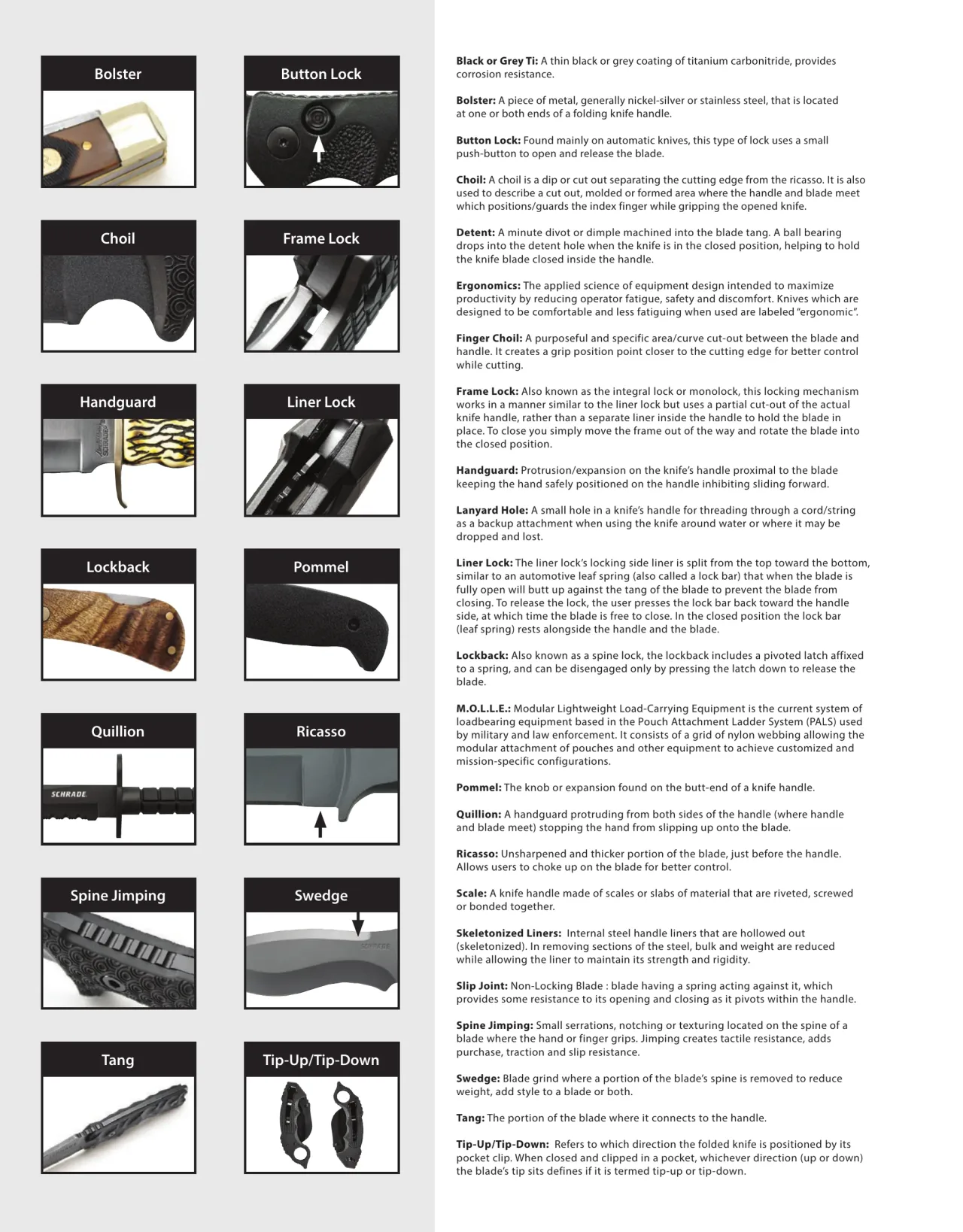
Bolster Button Lock corrosion resistance.
Bolster: A piece of metal, generally nickel-silver or stainless steel, that is located
at one or both ends of a folding knife handle.
Button Lock: Found mainly on automatic knives, this type of lock uses a small
push-button to open and release the blade.
Choil: A choil is a dip or cut out separating the cutting edge from the ricasso. It is also
used to describe a cut out, molded or formed area where the handle and blade meet
which positions/guards the index finger while gripping the opened knife.
Detent: A minute divot or dimple machined into the blade tang. A ball bearing
Choil Frame Lock drops into the detent hole when the knife is in the closed position, helping to hold
the knife blade closed inside the handle.
Ergonomics: The applied science of equipment design intended to maximize
productivity by reducing operator fatigue, safety and discomfort. Knives which are
designed to be comfortable and less fatiguing when used are labeled “ergonomic”.
Finger Choil: A purposeful and specific area/curve cut-out between the blade and
handle. It creates a grip position point closer to the cutting edge for better control
while cutting.
Frame Lock: Also known as the integral lock or monolock, this locking mechanism
Handguard Liner Lock works in a manner similar to the liner lock but uses a partial cut-out of the actual
knife handle, rather than a separate liner inside the handle to hold the blade in
place. To close you simply move the frame out of the way and rotate the blade into
the closed position.
Handguard: Protrusion/expansion on the knife’s handle proximal to the blade
keeping the hand safely positioned on the handle inhibiting sliding forward.
Lanyard Hole: A small hole in a knife’s handle for threading through a cord/string
as a backup attachment when using the knife around water or where it may be
dropped and lost.
Lockback Pommel Liner Lock: The liner lock’s locking side liner is split from the top toward the bottom,
similar to an automotive leaf spring (also called a lock bar) that when the blade is
fully open will butt up against the tang of the blade to prevent the blade from
closing. To release the lock, the user presses the lock bar back toward the handle
side, at which time the blade is free to close. In the closed position the lock bar
(leaf spring) rests alongside the handle and the blade.
Lockback: Also known as a spine lock, the lockback includes a pivoted latch affixed
to a spring, and can be disengaged only by pressing the latch down to release the
blade.
M.O.L.L.E.: Modular Lightweight Load-Carrying Equipment is the current system of
loadbearing equipment based in the Pouch Attachment Ladder System (PALS) used
Quillion Ricasso by military and law enforcement. It consists of a grid of nylon webbing allowing the
modular attachment of pouches and other equipment to achieve customized and
mission-specific configurations.
Pommel: The knob or expansion found on the butt-end of a knife handle.
Quillion: A handguard protruding from both sides of the handle (where handle
and blade meet) stopping the hand from slipping up onto the blade.
Ricasso: Unsharpened and thicker portion of the blade, just before the handle.
Allows users to choke up on the blade for better control.
Spine Jimping Swedge Scale: A knife handle made of scales or slabs of material that are riveted, screwed
or bonded together.
Skeletonized Liners: Internal steel handle liners that are hollowed out
(skeletonized). In removing sections of the steel, bulk and weight are reduced
while allowing the liner to maintain its strength and rigidity.
Slip Joint: Non-Locking Blade : blade having a spring acting against it, which
provides some resistance to its opening and closing as it pivots within the handle.
Spine Jimping: Small serrations, notching or texturing located on the spine of a
blade where the hand or finger grips. Jimping creates tactile resistance, adds
purchase, traction and slip resistance.
Tang Tip-Up/Tip-Down
Swedge: Blade grind where a portion of the blade’s spine is removed to reduce
weight, add style to a blade or both.
Tang: The portion of the blade where it connects to the handle.
Tip-Up/Tip-Down: Refers to which direction the folded knife is positioned by its
pocket clip. When closed and clipped in a pocket, whichever direction (up or down)
the blade’s tip sits defines if it is termed tip-up or tip-down.
194